
Showing posts with label medicine. Show all posts
Showing posts with label medicine. Show all posts
Friday, March 6, 2026

Friday, September 12, 2025
A Wow from Science

If the science is challenging to digest, my everyday doctor's interpretation is as follows:
Researchers previously viewed a whole category of protein segments as overly simplistic and of little use in the body, disdainfully labelling them "Intrinsically disordered protein regions." However, further studies have revealed that these segments are very useful indeed and not at all disordered. Rather than having a singular shape, they fold into functional structures depending on their environment, serving many important roles in the body. With simple repeated units, they make superstructures that we could not live without.
Imagine a kind of simple-looking metal that, if you pile it up in a city, forms itself into a skyscraper. Or if you dump it in a field, turns into a plow. And if you carry a little of it on your walk and it starts raining, an umbrella appears. That is what several of these chemical chains do in your body, depending on where they find themselves. And we had no idea until Dr. Gorlich and Dr. McKnight watched and listened and wrote and taught and went to conferences and sat at benches pouring chemicals back and forth year after year and discovered what was happening.
Truly Solomon was correct when he said: "It is the glory of God to conceal a matter, to search out a matter is the glory of kings." (Prov 25:2)
Paul B
Saturday, March 15, 2025
Of Specialists
I tell you, the old-fashioned doctor who treated all diseases has completely disappeared, now there are only specialists, and they advertise all the time in the newspapers. If your nose hurts, they send you to Paris: there's a European specialist there, he treats noses. You go to Paris, he examines your nose: I can treat only your right nostril, he says, I don't treat left nostrils, it's not my specialty, but after me, go to Vienna, there's a separate specialist there who will finish treating your left nostril.
- Dostoevsky (1821-1881)
Thursday, March 13, 2025
An Amazing Time in Kenya

Tuberculosis and HIV. Various-colored glasses. Baboons. Time with my daughter. Rice and beans and fried tomatoes. I wanted to reflect a few amazing things from our time at Kijabe Mission hospital in Kenya last month. It was a wonderful opportunity to serve, along with my med-student daughter Erika. We worked on the general inpatient wards, along with awesome local and expatriate staff, interns, and medical students.


Despite countless voyages at over 30,000 feet to get over oceans and around the globe, I remain amazed at safe transport and God's protection. Getting in one of those massive Boeing or Airbus tubes is magical, like C.S. Lewis or Stargate, where you wake up a little foggy and with indigestion, but in another world altogether.


I am amazed at my daughter, her hard work and determination means that she will graduate med school in May. She worked hard on the wards, amazing the interns who kept asking her to pull night call with them, knowing her hard work would benefit the patients and help them get more priceless minutes of shut-eye. It is a great blessing to share the field of medicine with her, bouncing cases off each other and commiserating when people don’t make it, such as her young woman patient with end-stage AIDS who we couldn’t save.

The faith and hard work of the doctors and nurses at Kijabe hospital was amazing to see. In America, we get so used to a medical environment efficiently cleansed of anything spiritual. In comparison, Kijabe felt like a feast: weekly chapel services rich with life-giving music, daily prayers before rounds, and colleagues who look to God for help, as well as to quality evidence-based resources.


Being in Kenya with Erika was amazing. Her Kenya memories were limited to milking cows and walking country roads from her last visit at age 6 with our friends the Kibaritas. That did not stop her from jumping into the current cultural challenge with creativity.
Seeing Erika and how she remembered her time in rural Kenya as a child, I thought it was amazing how differently we translate the world into our mind and memories at different ages. It is like we are wearing different pairs of glasses that emphasize different shapes and colors.

How we see the world depends so much on the glasses we are wearing. It is so easy to put on the glasses of pessimism and negativity. We can defensively wear glasses that look down others. The Bible mentions glasses Jesus wore: "have this attitude in yourselves which was also in Christ Jesus...who emptied himself..." These are humility glasses. Jesus purposefully looked at people asking himself: how can I serve them? Not as better than them, but seeing them first before himself. These glasses keep slipping off my face.

We saw an amazing array of diseases at the hospital in the few weeks we were there. TB, various cancers, malaria, HIV, diabetes and its complications, strokes and heart attacks. But people are not diseases, they are people. Whether their bodies improve or not, healthy connections between caregivers and patients is a good thing. Those who suffer need those who are blessed with health and resources. Erika was especially amazed by the selfless service of Dr Lapore, one of the Kenyan doctors working at the hospital. She trained in Russia, feeling a call to medicine, pushing through to learn enough Russian not only to pass but to excel.
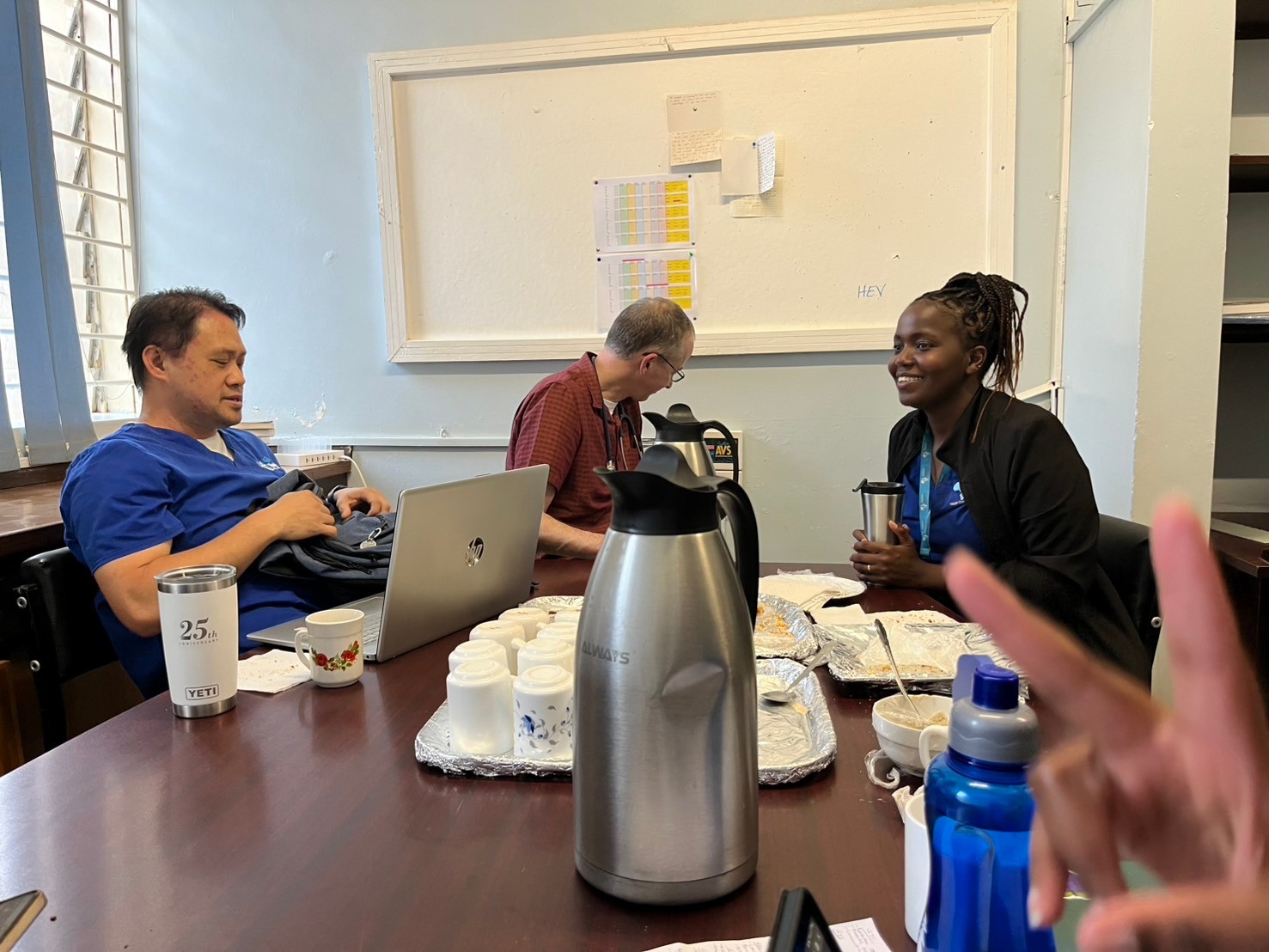 |
| Dr Lapore on the right. Medicine Chief Dr. Tony Nguyen on the left. |
The pathway to humility is through the humble valley. Having to ask for help interpreting, finding which meds are available, how to make things happen in a new culture, is humbling. Hopefully we grew through this process, and can keep those Jesus glasses on, like the decorations on the bus below.
 |
| Chapel on Wednesday Mornings |
 |
| Christian Bus Culture? And "Stay Humble!" |
Erika and I had a day to see some of the animals which East Africa is famous for. Kijabe is on the steep edge of the Rift valley. A drive to the bottom brings you to Lake Naivasha, where you can walk around with zebras, gazelles, giraffes, ostriches, hippos and endless varieties of birds large and small. No lions or Elephants there—but you don’t want to be walking with those anyway. It was an amazing opportunity. Back at the hospital grounds, there were plenty of monkeys and baboons showing off, but we were told to keep our doors and windows locked lest they gain entrance, steal our food, and make a mess.


 |
| monkey on the hospital roof |
 |
| Baboon at the hospital |
 |
| John and Esther |
In summary, it was an amazing time in Kenya. Thank you so much for praying for us. If you are interested in supporting the work there, I suggest a donation to World Medical Mission. They organized our trip, and do amazing work around the world:
https://www.samaritanspurse.org/medical/world-medical-mission/
Friday, May 3, 2019
What kind of doctor do I want to be?

If we use the language of
business to describe medicine, it changes who we are and what we do as
providers.
Monday, October 6, 2014
Kill Off The Zombies
This opinion piece from CNN is talking about the Ebola Crisis:
"It raises an interesting legal and moral question, one any fan of the zombie genre has wondered about: If one of our citizens is living but fatally infected, and will harm others if allowed to live out their doomed life, does the state's broad authority include authority to terminate the infected? At what point would we be comfortable with that? In the zombie movies, it's a no-brainer: generally, as soon as the group knows someone's infected, execution follows. And it's not always humane. Don't think we're above that in the real world. If the life of one threatens millions, does the state's police power authorize the pre-emptive taking of that one life?"
This un-useful extremist theorizing plays on fears and nightmares, but does show an important underlying error that is not uncommon in Western society. That is, that Ethics is only about maximizing. A modern person, devoid of underlying transcendental philosophical foundations, can only work with legal concepts such as personal rights and freedoms when considering ethical dilemmas. So it becomes a matter for the lawyers and the accountants to add up the particular points on one side and the other and see who has more at the end: more lives, more freedoms. At the same time, the modern person knows that this cannot possibly be all there is. But fearing that this line of reasoning will lead to something embarrassing such as a belief in God, she suppresses it.
So, modern thinker, listen up: you do not have to limit your mind and heart in this way. Allow your reason to explore this area. Is this an adequate way to look at the complexity of the world, the value of life, the beauty of creation? Is the reason you cannot answer this question evidence of a spiritual reality? In your heart you know that there will be a reckoning one day. There must be a power, a source of ethics that is more than what the statisticians can calculate.
In the mean time, do not let fear and anxiety lead your heart and mind. The Ebola crisis can be fought and is being fought by brave men and women, primarily African, on the ground in West Africa. If you want to help, send some money to one of the NGO's. Or volunteer yourself if you are in the medical field or logistics. But don't just get attention for yourself by useless articles promoting more fear.
"It raises an interesting legal and moral question, one any fan of the zombie genre has wondered about: If one of our citizens is living but fatally infected, and will harm others if allowed to live out their doomed life, does the state's broad authority include authority to terminate the infected? At what point would we be comfortable with that? In the zombie movies, it's a no-brainer: generally, as soon as the group knows someone's infected, execution follows. And it's not always humane. Don't think we're above that in the real world. If the life of one threatens millions, does the state's police power authorize the pre-emptive taking of that one life?"
This un-useful extremist theorizing plays on fears and nightmares, but does show an important underlying error that is not uncommon in Western society. That is, that Ethics is only about maximizing. A modern person, devoid of underlying transcendental philosophical foundations, can only work with legal concepts such as personal rights and freedoms when considering ethical dilemmas. So it becomes a matter for the lawyers and the accountants to add up the particular points on one side and the other and see who has more at the end: more lives, more freedoms. At the same time, the modern person knows that this cannot possibly be all there is. But fearing that this line of reasoning will lead to something embarrassing such as a belief in God, she suppresses it.
So, modern thinker, listen up: you do not have to limit your mind and heart in this way. Allow your reason to explore this area. Is this an adequate way to look at the complexity of the world, the value of life, the beauty of creation? Is the reason you cannot answer this question evidence of a spiritual reality? In your heart you know that there will be a reckoning one day. There must be a power, a source of ethics that is more than what the statisticians can calculate.
In the mean time, do not let fear and anxiety lead your heart and mind. The Ebola crisis can be fought and is being fought by brave men and women, primarily African, on the ground in West Africa. If you want to help, send some money to one of the NGO's. Or volunteer yourself if you are in the medical field or logistics. But don't just get attention for yourself by useless articles promoting more fear.
Sunday, December 11, 2011
Of Beginnings and Ends
 We talk much in medicine about the end of life. How do we know when it will end (prognosis)? How do we prevent death (treatment)? How do we comfort those in their last days (palliation)? But what do we really know about these questions of beginnings and ends?
 I notice that many of our discussions focus on the “end of life.” As if life has an end. In all of history, what religion or culture has said that this moment of last breath was the complete end? All connect the life to the living that remain, or those who have “gone” before. Or adding hereafter, look also to that same life going on unseen elsewhere. Who has not been affected by those whose lives are over? Those loved ones we carry with us. Or even the multitude we have not met who impact our lives now in one way or anther: Plato, Freud, Stalin, Jesus? Their lives are “over,” but are they? When did we adopt terms better used in the lab or the courtroom for thinking about the “end” of life when it comes to meaning, being human, or making decisions about “end of life care.” (there we go again)
And for that matter, what does the “beginning” of life mean? Knowing now what the ancients did not, that if you look at a sperm and an egg under the microscope, they have a set time of fusion; does that mean we have defined the beginning of life? How has even the Christian Church been so quick to adopt this moment, ignoring the stories of life formed from dirt, from ribs, at the indefinable “beginning” of time, from a God with life, no beginning and no end?
And as for science, what have we as moderns added with our great stores of knowledge? We still use a beginning and end in the same simplistic way, throwing away what we know to again adopt words from the courtroom or the congress such as autonomy and individual. What of mitochondria that span thousands of generations, truly tying us all together with a single mother of yore. What of Lucy the transitional, of stone tools and an iron age, can we truly say with any authority that my life began with me? What of my own tail that was resorbed, my blastocyst stage (when I was more pond scum than biped)? Or what of toilet training, adolescence, are not those beginnings and ends as well?
So the complexity grows and the discussion could continue as well, encompassing all. Let us, as doctors and otherwise, take off our shoes and bow our heads when we approach issues of beginnings and ends of life. It was wisdom, not foolishness, that made the ancients call in holy men and women at these moments. And if we find ourselves there for reasons of science or otherwise, whether it be the delivery room or the palliative care room, or for that matter the classroom of discussion, may we foster things like silence and awe in ourselves and others and not be limited to only procedures and check boxes. And may we realize how limited we are and how we limit our understanding of life with this vocabulary of beginnings and ends.
Thursday, July 14, 2011
A Week In Haiti


To learn more about the organization, you can visit the Project Medishare website.
To read a more detailed report of a night working in the Emergency room, please click here.
Thanks so much for supporting and praying for me and everyone trying to help out. Please remember the people of Haiti, so many struggling and working and serving to make things better.
Wednesday, June 29, 2011
Chronic Pain Treatment

"There are people who really need access to pharmaceuticals to manage their pain and there are some who abuse the pharmaceuticals, but the abusers are a very-very small proportion of those who need but don't have access to the treatment."
This is from the recent Institute of Medicine (IOM) report on chronic pain in America. See this article for details.
This philosophy reflects the idea that the doctors of the world have the duty to provide all people of the country with complete pain control. While in part a laudable goal, this idea is contributing to a massive over-use of narcotic prescriptions in the U.S. right now. When faced with a problem like this, we must ask ourselves many questions that as yet have not been adequately addressed:
1. Are narcotics the best plan for chronic pain that does not respond to other medications?
2. Can we fully rely on the patient who is taking narcotics, who 100% of the time develops tolerance and other features of dependency when taking narcotics for chronic pain, to tell us whether or not this is the best management? Even if he is behaving himself by not selling or otherwise "misusing" the medication?
3. We cannot only look at the pain control aspect: what are the philosophical, ethical, sociological, and other ramifications of using narcotics for chronic pain?
4. Even those patients who never "abuse" the medications, what are the ramifications of this legalized drug?
Note heroin was initially a prescription drug. And it worked well for pain. But the societal effects were to damaging and it lost favor. Let us be careful!
Monday, January 24, 2011
A Week In Haiti
 |
| Part of a Tent City -- Too many still there |
56 year old female diabetic with necrotizing fasciitis and sepsis had left above the knee amputation is still on the ventilator after surgery…
12 year old female with total body paralysis with multiple complications on the ventilator…
46 year old man with non-healing ulcer on the thigh for unknown reason, has been here on antibiotics for 2 months…
Your food will show up on your bed (down the hall from the patient wards) at 10 am and 2 pm, you can eat it when you like…
You are not to leave the hospital compound for any reason. The election results are coming out and there may be riots…
 |
| In the ICU |
Cholera patients are to be stabilized and then sent to the local cholera treatment centers. Make sure to decontaminate with bleach when leaving the cholera treatment area behind the hospital…
Words of introduction that we received as we checked in to the Bernard Mevs hospital in Port-Au-Prince, Haiti on New Year’s Day, as the outgoing team prepared to leave in the afternoon back to Florida. I spent the week as the main inpatient doctor for this small hospital in Haiti’s capital. I was with a team of doctors and nurses from the States, working with Haitian doctors and nurses caring for some of the sick in a country that has seen much hardship.
 |
| One of the Surgery Cases - Dr. Seth |
I have gone on quite a few volunteer trips over the years, and I thought this one would be somewhat different: I was right. Teams from “Project Medishare,” have been rotating through on a weekly basis regularly since the earthquake last year, first in a tent hospital at the airport, and for the last several months at the current location, partnering with an already-established hospital. Initially very busy with surgeries on the injured, now the focus is more on medical conditions and rehabilitation, though new trauma patients also come in. And of course there is cholera.
The week was very full. We treated many patients with high quality medical care. Despite language and culture barriers, the Haitian staff and the American volunteers worked well together. The numerous translators of course were indispensible, and it was fun to use my French skills, which have been rusting over 20 years of disuse.
Highs and lows included seeing the 12-year-old girl get transported to the U.S. for more care, through the generosity of many kind donors. Seeing a spinal injured patient get stable enough to reach his goal of going home. Losing a severe cholera patient to a sickle crisis after successfully pulling him back from death once. Teaching Haitian medical students. Every day was full of interesting and demanding medical work. And I was able to grab a few precious minutes alone with my Bible in the mornings in a secluded courtyard.
 |
| In the hospital Courtyard |
Jennifer asks me: what did God teach me through this trip? Probably several things: That it is difficult to get a good understanding of peoples’ suffering by watching television. That simply doing a good job in your field is of great physical and even spiritual value.
I must thank God for providing the opportunity to go on this short trip. And also those who prayed and supported me, not the least of which was my wife Jenifer who has to care for the household while I am away and is a trip-organizer extraordinaire!
Why do I keep up with overseas volunteering? Several reasons probably: I want to make a difference. I hope to be of help where the need is great. It is very interesting medically. It is an adventure. I find other cultures and peoples fascinating. But I hope and pray most of all it is the Lord Jesus working in and through me in His love, in spite of myself many times.
 |
| Dr Barry, Dr Paul and Translator |
Please continue to remember the people of Haiti in their suffering. There are many worthy people there who love their country and are doing their very best to make it better; pray for them and for God’s mercy in their rebuilding, and the battle against cholera.
Paul Bunge, MD
P.S. You may be interested in helping out financially with some of the projects in Haiti. Consider one of the following agencies working there:
Project Medishare
Samaritan’s Purse
And to fund scientific research into spinal injuries, consider the University of Miami’s “The Miami Project to Cure Paralysis”:
Wednesday, January 12, 2011
It's Easer to Get a Gun than Mental Health Care
by Dora Calott Wang, M.D. in Psychiatry Today
For decades, the American health care system has prioritized profits, often by excluding the sick. This travesty is now coming to roost, in the form of mass violence, such as the recent shootings in Tucson, at Virginia Tech, and in communities across the country, including my own. Medical care for our most disenfranchised citizens will never turn good profits-yet basic health care for everyone, is necessary for the stability of society.
Mass shootings are a symptom of our broken health care system.
Published on January 12, 2011
There will be more shooting rampages, like that which targeted Congresswoman Gabrielle Giffords in Tucson last weekend-as long as it is easier to get a gun than mental health care. Our current epidemic of mass shootings is but a symptom of our nation's broken health care system. Poor access to medical care jeopardizes an individual's health. But when the mentally ill or the seriously distressed can't access care, we are all at risk.
As a psychiatrist, I remember when I once did everything in my power to keep a disturbed patient stable, and society safe. I'd see the patient every day, or hospitalize the patient for months, if necessary. Needless to say, this degree of attention is impossible today, given limited resources, and the fights my staff and I regularly undertake with insurance companies to get even routine care approved.
As a psychiatrist, I remember when I once did everything in my power to keep a disturbed patient stable, and society safe. I'd see the patient every day, or hospitalize the patient for months, if necessary. Needless to say, this degree of attention is impossible today, given limited resources, and the fights my staff and I regularly undertake with insurance companies to get even routine care approved.
For decades, the American health care system has prioritized profits, often by excluding the sick. This travesty is now coming to roost, in the form of mass violence, such as the recent shootings in Tucson, at Virginia Tech, and in communities across the country, including my own. Medical care for our most disenfranchised citizens will never turn good profits-yet basic health care for everyone, is necessary for the stability of society.
What does it mean that for kids today, the greatest threat of mass violence comes not from enemy powers, but from fellow disenfranchised citizens? As opposed to the duck and cover bomb drills of my own childhood, schoolchildren today do drills to prepare for shootings. Across the country, uniformed officers with weapons rush onto campuses to tackle imaginary shooters, while students run for cover. In Oxford, CT, helicopters and over 150 officers helped stage an elaborate shooting drill. At Scales Elementary School in Tennessee, little kids cried and wet their pants during a drill. In Dallas, police mistook a drill for an actual attack, and rushed onto campus like an episode of Keystone Cops. What have we come to?
Insurance companies have the ultimate say about how often I see a patient, what medications I prescribe, and if the patient can be hospitalized. In the past, I might have provided services free of charge, in the name of patient welfare, my own professional ethics, or for the sake of public safety. But physicians and hospitals who don't prioritize the bottom line are increasingly put out of business. Even St. Vincent Hospital in Manhattan, after 161 years of practicing good medicine but bad business, is bankrupt, gone. Meanwhile, health insurers are among the most profitable companies on Wall Street. It's a perverse distribution of the nation's precious medical dollars.
My own community's worst mass shooting occurred on August 18, 2005, when five people in Albuquerque were shot and murdered by a man who suffers from schizophrenia. For the prior three days, John Hyde sought help, but was turned away each time. His family called his psychiatrist repetitively, but HIPAA privacy laws prevented communications. On the day Hyde started shooting, he sought help from his insurance company.
Hyde was once kept stable for seven years by an old-fashioned psychiatrist who had personal relationships with patients, and who was available at all hours, like all doctors of another time. But when for-profit insurance companies took control of New Mexico's mental health dollars in 1998, Hyde's psychiatrist found himself paid less, while needing to spend just as much time haggling with insurance bureaucrats, as treating patients. In 1998, practicing the same devoted way he had for 22 years, Hyde's psychiatrist, Dr. Jay Feierman, closed his practice with $50,000 in debt.
After Hyde lost the long-term, committed care of his personal psychiatrist, Hyde fell into a system that operates in today's typical fashion. His care was divided between a psychologist for therapy, a psychiatrist for medications, an Emergency Room for problems after hours (which is most hours of the week), with insurance bureaucrats ultimately at the helm of each medical decision. With Dr. Feierman, at least Hyde knew who to call, if he felt unstable.
Effective treatments for serious mental illness only began with antipsychotic medications created in the 1950's. An older, more primary function of psychiatry-dating from the time of asylums-has always been to keep society safe.
We as a society are only as stable as the least stable individual roaming our streets.
How many more tragedies need occur, before we conclude that our mental health care system no longer functions to keep us safe? When will we learn that everyone needs basic medical care, not just for humanitarian reasons, but for the safety of all of us?
 Dr. Wang wrote The Kitchen Shrink: A Psychiatrist's Reflections on Healing in a Changing World. I thought the above piece is very relevant so I quoted it in its entirety.
Insurance companies have the ultimate say about how often I see a patient, what medications I prescribe, and if the patient can be hospitalized. In the past, I might have provided services free of charge, in the name of patient welfare, my own professional ethics, or for the sake of public safety. But physicians and hospitals who don't prioritize the bottom line are increasingly put out of business. Even St. Vincent Hospital in Manhattan, after 161 years of practicing good medicine but bad business, is bankrupt, gone. Meanwhile, health insurers are among the most profitable companies on Wall Street. It's a perverse distribution of the nation's precious medical dollars.
My own community's worst mass shooting occurred on August 18, 2005, when five people in Albuquerque were shot and murdered by a man who suffers from schizophrenia. For the prior three days, John Hyde sought help, but was turned away each time. His family called his psychiatrist repetitively, but HIPAA privacy laws prevented communications. On the day Hyde started shooting, he sought help from his insurance company.
Hyde was once kept stable for seven years by an old-fashioned psychiatrist who had personal relationships with patients, and who was available at all hours, like all doctors of another time. But when for-profit insurance companies took control of New Mexico's mental health dollars in 1998, Hyde's psychiatrist found himself paid less, while needing to spend just as much time haggling with insurance bureaucrats, as treating patients. In 1998, practicing the same devoted way he had for 22 years, Hyde's psychiatrist, Dr. Jay Feierman, closed his practice with $50,000 in debt.
After Hyde lost the long-term, committed care of his personal psychiatrist, Hyde fell into a system that operates in today's typical fashion. His care was divided between a psychologist for therapy, a psychiatrist for medications, an Emergency Room for problems after hours (which is most hours of the week), with insurance bureaucrats ultimately at the helm of each medical decision. With Dr. Feierman, at least Hyde knew who to call, if he felt unstable.
Effective treatments for serious mental illness only began with antipsychotic medications created in the 1950's. An older, more primary function of psychiatry-dating from the time of asylums-has always been to keep society safe.
We as a society are only as stable as the least stable individual roaming our streets.
How many more tragedies need occur, before we conclude that our mental health care system no longer functions to keep us safe? When will we learn that everyone needs basic medical care, not just for humanitarian reasons, but for the safety of all of us?

Monday, November 1, 2010
Sickness

"Some people think it's an insult to the glory of their sickness to get well. But the time poultice is no respecter of glories. Everyone gets well if he waits around."
-John Steinbeck (East of Eden)
Thursday, September 10, 2009
2.3 BILLION dollar fine!!
It has always seemed to me from the press over the years, following the medical literature, and talking with many drug reps, that Pfizer has been in some ways the more mischievous of the large American drug companies. The most likely to keep a questionable med on the market. The most likely to be doing shady research. The most likely to push for overuse of their medication. I hypothesize that the corporate culture of Pfizer has suffered from a deficit of knowledge of and/or respect for the ethical principles of medical care. If this is true, then these fines and more rules are not enough.
resources
It has always seemed to me from the press over the years, following the medical literature, and talking with many drug reps, that Pfizer has been in some ways the more mischievous of the large American drug companies. The most likely to keep a questionable med on the market. The most likely to be doing shady research. The most likely to push for overuse of their medication. I hypothesize that the corporate culture of Pfizer has suffered from a deficit of knowledge of and/or respect for the ethical principles of medical care. If this is true, then these fines and more rules are not enough.
resources
Saturday, January 5, 2008
The many and the few
In how many areas is it found that people "prefer to gain their bread with the many rather than subsist on the good opinion of the few." (Cervantes, in Don Quixote)
I know this is often true in medicine, where the thinking doctor, who wishes to promote good health, avoid unneeded therapies, and focus his (or her) attention on cases that can derive the most benefit, will find himself left out in the cold by the others who give in to processing patients as in a factory, looking for what can make money rather than what can make health, and pursue all possible tests and therapies (or avoid all possible of the same depending on the payment scheme's reward system).
I know this is often true in medicine, where the thinking doctor, who wishes to promote good health, avoid unneeded therapies, and focus his (or her) attention on cases that can derive the most benefit, will find himself left out in the cold by the others who give in to processing patients as in a factory, looking for what can make money rather than what can make health, and pursue all possible tests and therapies (or avoid all possible of the same depending on the payment scheme's reward system).
Sunday, December 23, 2007
Disability
In a way of disability
Leg held in a trap
Looking always for a way out
But seeing every time
a worsening with the attempt
Looking out from inside
People with fear rush by
Too long it has gone on for sympathy
For them and for me
Soothing body and mind
I drift away
A cloud of pain killers
That wicked mistress
copywrite Paul Bunge 2007
Leg held in a trap
Looking always for a way out
But seeing every time
a worsening with the attempt
Looking out from inside
People with fear rush by
Too long it has gone on for sympathy
For them and for me
Soothing body and mind
I drift away
A cloud of pain killers
That wicked mistress
copywrite Paul Bunge 2007
Subscribe to:
Posts (Atom)