Showing posts with label Africa. Show all posts

Thursday, March 13, 2025

An Amazing Time in Kenya


Tuberculosis and HIV. Various-colored glasses. Baboons. Time with my daughter. Rice and beans and fried tomatoes. I wanted to reflect a few amazing things from our time at Kijabe Mission hospital in Kenya last month. It was a wonderful opportunity to serve, along with my med-student daughter Erika. We worked on the general inpatient wards, along with awesome local and expatriate staff, interns, and medical students. 


Despite countless voyages at over 30,000 feet to get over oceans and around the globe, I remain amazed at safe transport and God's protection. Getting in one of those massive Boeing or Airbus tubes is magical, like C.S. Lewis or Stargate, where you wake up a little foggy and with indigestion, but in another world altogether.


I am amazed at my daughter, her hard work and determination means that she will graduate med school in May. She worked hard on the wards, amazing the interns who kept asking her to pull night call with them, knowing her hard work would benefit the patients and help them get more priceless minutes of shut-eye. It is a great blessing to share the field of medicine with her, bouncing cases off each other and commiserating when people don’t make it, such as her young woman patient with end-stage AIDS who we couldn’t save. 


The faith and hard work of the doctors and nurses at Kijabe hospital was amazing to see. In America, we get so used to a medical environment efficiently cleansed of anything spiritual. In comparison, Kijabe felt like a feast: weekly chapel services rich with life-giving music, daily prayers before rounds, and colleagues who look to God for help, as well as to quality evidence-based resources. 


Being in Kenya with Erika was amazing. Her Kenya memories were limited to milking cows and walking country roads from her last visit at age 6 with our friends the Kibaritas. That did not stop her from jumping into the current cultural challenge with creativity.


Seeing Erika and how she remembered her time in rural Kenya as a child, I thought it was amazing how differently we translate the world into our mind and memories at different ages. It is like we are wearing different pairs of glasses that emphasize different shapes and colors. 


How we see the world depends so much on the glasses we are wearing. It is so easy to put on the glasses of pessimism and negativity. We can defensively wear glasses that look down others. The Bible mentions glasses Jesus wore: "have this attitude in yourselves which was also in Christ Jesus...who emptied himself..." These are humility glasses. Jesus purposefully looked at people asking himself: how can I serve them? Not as better than them, but seeing them first before himself. These glasses keep slipping off my face.


We saw an amazing array of diseases at the hospital in the few weeks we were there. TB, various cancers, malaria, HIV, diabetes and its complications, strokes and heart attacks. But people are not diseases, they are people. Whether their bodies improve or not, healthy connections between caregivers and patients is a good thing. Those who suffer need those who are blessed with health and resources. Erika was especially amazed by the selfless service of Dr Lapore, one of the Kenyan doctors working at the hospital. She trained in Russia, feeling a call to medicine, pushing through to learn enough Russian not only to pass but to excel.
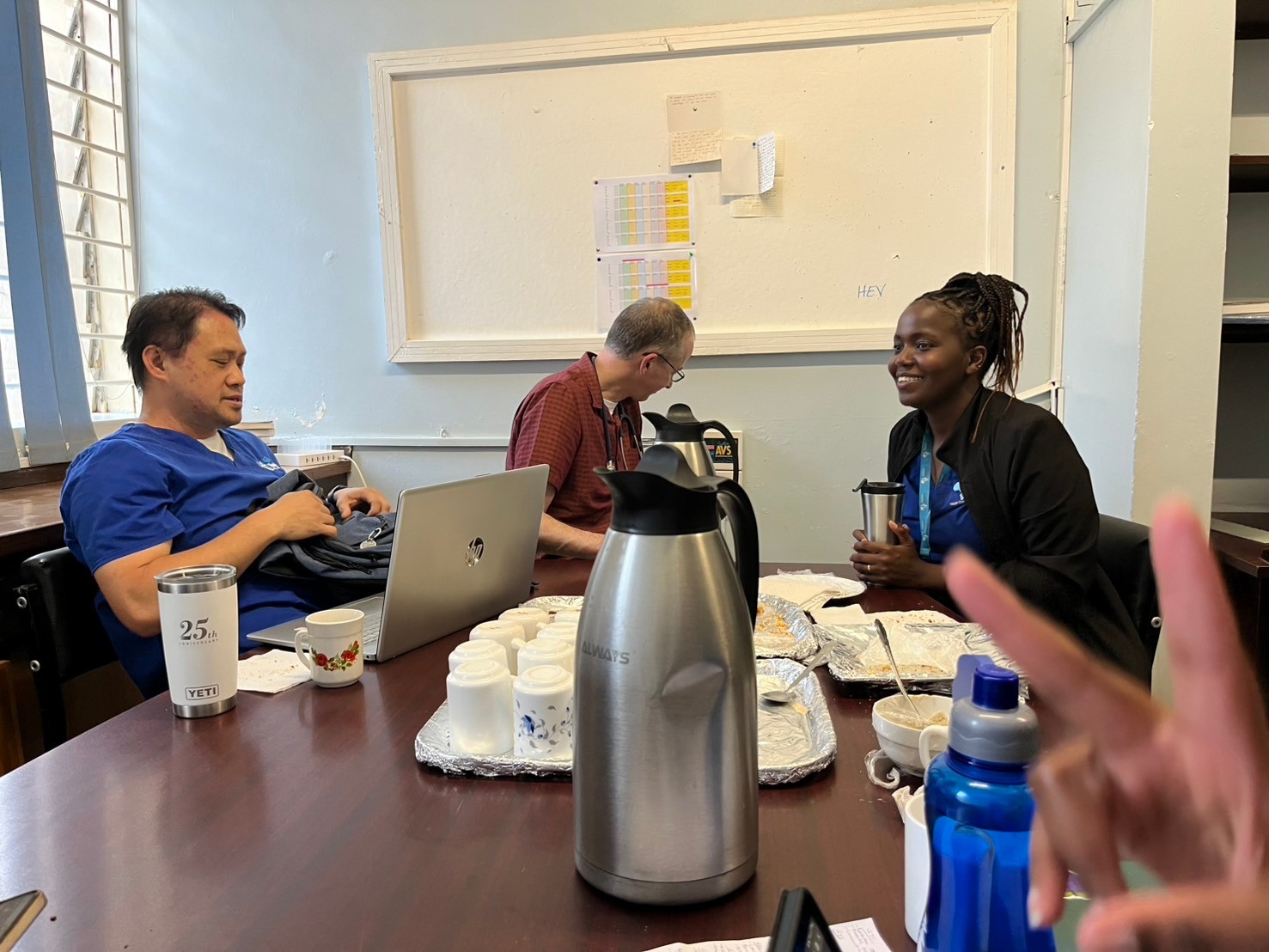
 

Dr Lapore on the right. Medicine Chief Dr. Tony Nguyen on the left.

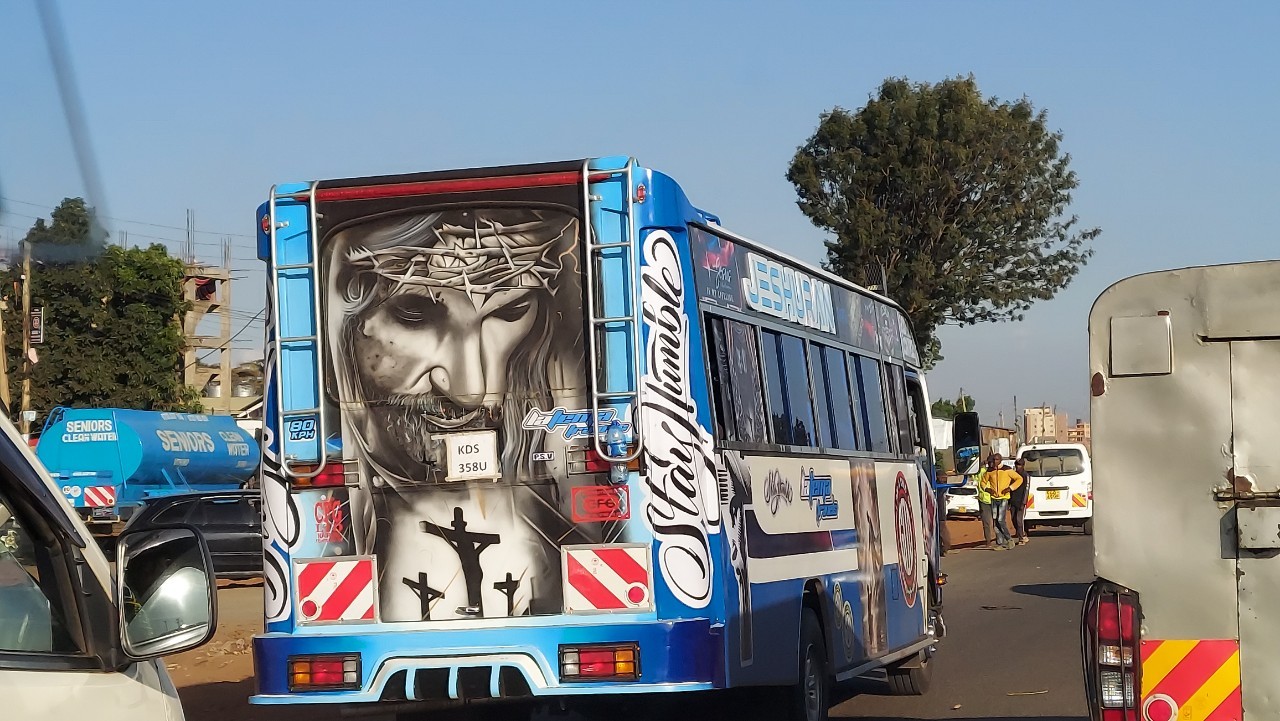
The pathway to humility is through the humble valley. Having to ask for help interpreting, finding which meds are available, how to make things happen in a new culture, is humbling. Hopefully we grew through this process, and can keep those Jesus glasses on, like the decorations on the bus below.


Chapel on Wednesday Mornings


Christian Bus Culture? And "Stay Humble!"

Erika and I had a day to see some of the animals which East Africa is famous for. Kijabe is on the steep edge of the Rift valley. A drive to the bottom brings you to Lake Naivasha, where you can walk around with zebras, gazelles, giraffes, ostriches, hippos and endless varieties of birds large and small. No lions or Elephants there—but you don’t want to be walking with those anyway. It was an amazing opportunity. Back at the hospital grounds, there were plenty of monkeys and baboons showing off, but we were told to keep our doors and windows locked lest they gain entrance, steal our food, and make a mess.


monkey on the hospital roof
Baboon at the hospital


John and Esther
It was so amazing to see old friends! Especially Pastor John and his wife Pastor Esther. A short visit but such a blessing.


In summary, it was an amazing time in Kenya. Thank you so much for praying for us. If you are interested in supporting the work there, I suggest a donation to World Medical Mission. They organized our trip, and do amazing work around the world:


https://www.samaritanspurse.org/medical/world-medical-mission/


Sunday, November 30, 2014

Is There A Doctor In the Room?

 (practicing in the days of Ebola)


This Article is Published in a shorter version in The Olympian.  Click here to read that version.

A longer (more raw?) version is below:


“Is There a Doctor in The Room?”  The question was asked by the chief surgical resident soon after he entered the trauma bay, full of confidence and clearly in charge in the midst of chaos.  He asked it after he had been informed that the nurses had been trying in vain to get an IV.  He knew the answer already.  Several intern doctors and medical students (like myself) were trying to help: getting our gloves on, wondering what to do next.  Afraid of death, which was obviously knocking, but excited at the same time to be where the action was.  We all questioned what he was getting at.  What did he want?  Did he not know?  Was this a trick question?  Was he trying to teach us something?

After the appropriate pause for effect, but not so long as to delay anything, and while putting on his own gloves, the chief explained,  “If there were a doctor in the room, he or she would have been getting a cut-down.”  Of course!  A venous cut-down.  We all secretly kicked ourselves for not already reaching for the minor surgical kit.  We could get IV access.  We had been trained in how to “cut down” through the skin to a superficial vein and grab it, get an IV in it and tie it up so it would not come out.  That way we knew we could get some fluid in.  I grabbed the kit and the chief and I did my first cut-down.

I think today it is time again to ask this question:  “Is there a doctor in the room?”   The today I am talking about is the day of Ebola.  The disease on the headlines.  This fearsome outbreak that has killed thousands in Africa and has reared its ugly head here in America as well.   There are newspapers.  There are lawyers.  There are many people scared out of their wits.  But the question is,  “Is there a doctor in the room?"

If there were a doctor in the room, he would go and treat the patient.  He would stop looking around and even though he had never seen such a patient before in his life.  He would dig into his brain and remember his training and come up with a logical, determined, and reasonable plan to do something about the problem.  He would do it, even if it made him shake in his boots.  He would do something even if his friends did nothing.  He would do something even if there were risks.

If there were a doctor in the room, she would volunteer to go to Africa and help treat the epidemic at the source.  Some have gone.  But recruiting doctors for this job has been very difficult.  Many working at the Ebola Treatment Centers are on their second or third rotation.  When the President of the United States put out a call for doctors to rise up and go, there was a surprising silence.  Aid organizations have the money and the logistics personnel, but few doctors.  

Is there a doctor in the room?

If there were a doctor in the room, she would stand up for reason and science and compassion for those returning from overseas.  Instead, we have a fight between governors and lawyers as the people panic in the street.  Doctors trained in the current era of  “guidelines” and “protocols” cannot function without them.  So they bow to whoever comes up with the plan that carries the least amount of risk, no matter the harm it may do in the end, even in the fight against this disease.  A doctor, knowing history and literature and people, not merely science, would explain to the people that no life is without risk.  A doctor would help bring people to balance, realizing that those who insist on an absolute risk-free life need therapy.  She would realize that to send people overseas means they will come back and need support and help, and they themselves will be a risk.

Is there a doctor in the room?

If there were a doctor in the room, he would put his suit on to see the Ebola patient.  He would know from lessons learned from prior outbreaks that a full body suit is required, with every inch of skin covered.  If there were a doctor in the room, he would do his best to find out who had treated Ebola patients before him, and he would realize it was the Africans and the Aid workers.  He would contact them and read their reports and see what they did.  He would not stop at full body covering. Until there was a clear reason to change strategies, he would do exactly what they do in Africa:  not let the Ebola patients into the hospital, treat them in a separate facility or tent, give them good supportive treatment with IV fluids, use chlorine based decontamination, send them to specialized centers for care.

So the question remains in the air, as it did those years ago.  That day of the gunshot and the blood.  The question that made all of us very uncomfortable, but at the same time gave all of us a flag to carry and a rallying point:  “Is there a doctor in the room?”

Thursday, November 13, 2014

Epidemic of Medical Care

http://www.janellepublications.com/4967.shtml


Dr Welch in his NY Times article points out that screening for thyroid cancer leads to more diagnosis but not likely better treatment or better care, but likely harms. 

I think it is very interesting as I think about these questions:

1.  What does a country look like that has too few doctors?  I was recently in Liberia, where the WHO registered 51 doctors for the country of over 4 million persons.  Several of those have died of Ebola.  I worked with facilities in Monrovia, where patients are cared for, babies delivered, simple treatments done by nurses mostly.  Research has shown that having a medical attendant for a delivery dramatically reduces maternal deaths. 

2.  What does a country look like that has too many doctors? This is where Dr Welch and the Lown Institute and the Dartmouth research helps us to understand that so much of our medical care is actually hurting us because of over-medicalization, over-treatment, over-testing, and certainly overspending on healthcare in America. 

In both situations--Liberia and the USA--one thing that strikes me is how invisible this issue seems in the regular everyday life of the people and the thinking of the medical workers.  The Liberian government, even today in the days of the Ebola crisis, still will ponder over your application for a medical license.   Providers wonder if a volunteer doctor will be unfair competition.  As if there was not an absolute desperate need.  And in America, new medical schools are still opening, with a call for more doctors in a "national shortage."  The fish does not notice the water she swims in.

And so it takes certain people, with a special vision, to help the rest to understand that realities of the medical establishment perhaps are different than we think. 

Sunday, August 31, 2014

Red Wrath of Ebola


In the depths of poverty, in the heat and the sweat of Western Africa, is the world of red.  Unique red dirt exposed by two great turners of the soil—the African termite raising great mounds of the crimson stuff, and people, clearing the rain forest to show the red clay previously hidden by lush and full vegetation.  The green stands ready to take it back over in an instant when untended. Formed of the clay, “road” is a seasonal term.  That which carries a vehicle in the dry season, swallows it in times of rain.  Houses of people, formed from the red clay into bricks, lose some of their deep color in the drying process as the sun shines mercilessly.   The hands of the farmer are red, constantly moving and forming this soil to make room for the crops.  Using the hand hoe is like spooning the ocean as she bends at the middle to reach dirt, a baby tied on her back.   Clothing is streaked and stained with the soil, mixing earth with the daring colors adopted in this part of the world.  Wearing something white is more like bringing out a canvas than a choice of fashion, for it is only a matter of time for the West African paintbrush to bring that permanent mark from the world of red.

A new red stain has come to this world.  As if years of civil war, anarchy, and misrule were not enough to satisfy whatever demons delight in the separating of the blood from the body of the black man, a people who fear cruel leaders now find an even greater wrath: Ebola.  At first it was a mystery as the patients passed blood in their feverish fits and then died.  But many and assorted doctors from other lands have come in plastic suits and rubber gloves, to diagnose this disease, label the outbreak and collect data.  What has worked in the past they have implemented in hospitals and tents:  intake, isolation, support.  In former days, this demon has been content to destroy a few villages in a quick but containable horror.  Now it has found its way across families and cities and even borders.  Fear and ignorance have been its friend, as patients hide from help, fearing isolation, and useless bush treatments cause even more damage.  One cannot help but notice an adaptation--patterns that have been effective over thousands of years--the isolated village, fear of others, independent beliefs and superstitions.  The village that has been for the people a place in this world, not only of survival in the midst of old-world disease, but a fertile thriving of family, culture, art, and even science and medicine. 

The doctor is the foreigner to the scene.  Yet that doctor or nurse was born and raised in West Africa, speaks an unwritten tribal language with his heart and not just his mouth. He nonetheless carries with him the foreign, the unusual, the new approach, saying: “no, we do not want to go back to the village, not like this.  We will use the modern tools to fight this disease, and deliver our people.”  The doctors from the West come as well, assistants to these noble men and women of Africa—all bravely risking their lives as the plague rages on. 

The West Africans have changed, dramatically so in fact.  They have laid down their guns, have stopped spilling each others' blood.  They have courageously used the ballot following no longer the empty promises of the bloodthirsty.  And in this outbreak, they have largely followed the request of their leaders to stop meeting, suspend schools, change their greetings which are so important to them.  They have followed the instructions of the world's designated smart people.  And yet, the blood still flows.

What will happen next in this great drama? There was another epidemic virus ravaging Africa, more in the East:  HIV.  It took many years for changes to take place to bring medications and resources already in use in developed countries to the continent.  A few visionaries worked diligently to bring to reality what most people thought impossible or at least impractical:  effective HIV treatments in Africa.  Having the treatments available not only saved lives, it vastly improved the ability to educate people and impact populations.  Those who knew there was a treatment were now willing to discuss the problem, get tested, and listen to the education needed to interrupt the spread. 

In the case of Ebola, there are medications and vaccines available, though they need further testing.  The development funding came in part from the US military, which planned to protect its soldiers from the disease.  Will visionaries be able to coordinate with the military, the Centers for Disease Control (CDC), the World Health Organization (WHO), the companies with patents, the doctors on the ground, the researchers, and others, to make treatments available?  Or will there be only nods of “supportive care” when it comes to Africans, who have nearly no access to supportive care in the sense the term is used in the West, which includes blood products and an ICU.

The whole world is nervous, affected, ready to act.  Money is offered.  What is needed is creativity.  Obviously, with a disease that has broken the boundaries of our experience, we need new approaches that break the boundaries of tradition to bring it under control.  Not forsaking what has worked in the past, not lightening up on containment, education, supportive care.  But creatively seeking cure.  Finding out which weapons work best in this kind of battle.  What sanitation systems are needed.  How the family and village support systems can be a help instead of a hindrance.  How an ICU and a blood bank can be built and, more importantly, supported, in such a setting.  How money from outside can be channeled usefully into the already existing research Universities and other structures in West Africa.

God's wrath is red, like the West African soil.  And yet so is the life-giving blood He put into every one of us.  Perhaps in His Providence, God has allowed this time that people whose blood is red might come to help their brothers and sisters in the world of red.